
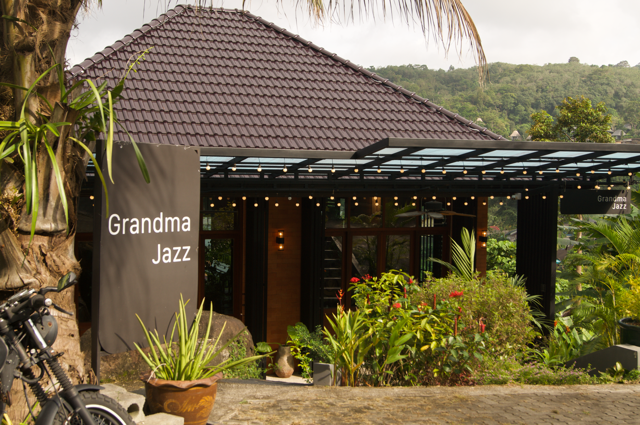
Perched on a quiet mountain in Kamala, on the west coast of Phuket, Thailand, there is a little café called Grandma Jazz that is quietly redefining cannabis culture — not through hype or luxury, but through warmth, connection, and conscience. A soft rebellion against the clichés that have long defined the scene.
When cannabis became legal, AC Correya who had moved to Thailand from the UK, noticed something missing. He thought “Most dispensaries focused on the product — the potency, the strain, the sale — but few seemed to consider the experience.”
“The word experience is exactly what we wanted to create,” says AC. “As a former actor, I learned a lot about how to generate a feeling from the audience. It’s always about what we see, what we hear, what we feel.”
AC recalls a moment of inspiration from a cigar bar in London.
“I remember how it felt stepping into that place,” he shares. “The way the chair was positioned privately, the smell of gentle perfume in the air, the mood, the lighting, the service that made me feel, for a moment, like a king. And I thought, everyone deserves this feeling. Not just those who can spend fifty pounds on a cigar in London, but anyone who walks through our doors. That’s the kind of luxury that should be for everyone — a luxury of feeling at home and cared for.”

AC Correya and Joy Vonglek, founders of the iconic Grandma Jazz Cafe in Phuket, Thailand
Grandma Jazz became that experiment in feeling — a space where the scent of coffee mingles with the laughter of friends, where music drifts like a slow exhale, and where especially the smallest details are considered. Handwritten customer quotes line the walls, each one a small story left behind by someone who found a little calm here.
And in this quiet mountain corner of Kamala, sustainability isn’t a buzzword. It’s a rhythm. From bamboo joint holders to refillable canvas bags, every ritual at Grandma Jazz ensures no one handles single-use plastic. These quiet choices have now carried the café beyond its 1,000th plastic-free day, making it the first dispensary in Thailand to do so.
But the mission goes beyond their doors. Through the GreenFlow Movement — supported by the Phuket Cannabis Association — AC and Joy Vonglek are encouraging other dispensaries to rethink their packaging, share refill systems, and see sustainability as part of cannabis culture itself.
“We love Thailand,” AC adds. “This is how we can prove it.”

A shifting cannabis law — and what it means for visitors
Since Grandma Jazz opened its doors on January 15, 2023, Thailand’s cannabis laws have moved through several seasons of change.
In 2018, Thailand became the first country in Asia to legalize medical cannabis. Then, in June 2022, the cannabis plant was removed from the country’s narcotics list — a landmark decision that effectively decriminalized possession and use, provided products stayed under 0.2% THC unless used medically.
What followed in 2022–2024 was a kind of wild spring. Dispensaries bloomed across Bangkok, Phuket and beyond. Officially, cannabis was meant for medical use, but in practice a grey area emerged: tourists and locals alike could walk into many shops and buy flower without being asked for a prescription. The world’s media called it a cannabis free-for-all; Thailand called it a work in progress.
By mid-2025, that “progress” arrived in the form of a sharp turn. New regulations reclassified cannabis flower as a controlled herb and tightened the rules around who can buy, sell, and consume it. Recreational use was rolled back; cannabis is now firmly framed as a medical substance again.
For visitors, the headline is simple but important:
• Tourists are no longer allowed to buy, carry, or use cannabis flower in Thailand without a valid medical prescription from a licensed Thai practitioner.
• That prescription is time-limited, logged, and must be available if authorities ask to see it.
• Public smoking remains illegal and can carry fines or even jail time, even if the cannabis itself is prescribed.
In other words: cannabis in Thailand is still here, but it is no longer a souvenir. It’s medicine, and the paperwork matters.
Grandma Jazz has chosen not just to adapt to these changes, but to make them as gentle as possible for the people who climb the hill to their door.
Today, every tourist who wishes to buy cannabis through Grandma Jazz moves through a simple, fully legal process inside the café. A staff member helps guests register; their details are sent to a licensed Thai doctor elsewhere in the country, who reviews the information and, when appropriate, issues a digital prescription that is signed off and returned within about ten minutes. The whole thing happens quietly in the background while guests sip tea, smell the flowers, and take in the view.
The result is that by the time someone chooses their flowers, they’re on the right side of the law — not walking a grey line on foreign soil.
“If you’re going to another country to enjoy legal cannabis, do it the legal way. It’s your holiday. You don’t want to spend it worrying about whether a small decision might become a big problem.”
At Grandma Jazz, that peace of mind is part of the experience. The flowers, the paperwork, the prescription — it’s all handled in-house so guests can simply exhale.

Music as a house rule
And then there’s the music. During high season, the café becomes an intimate stage every weekend for Saturday Sessions — live performances captured in 360° and shared on YouTube. Musicians from around the world drop by at 4:20 p.m., raw, improvised, or otherwise, blending jazz, soul, and spontaneity. Those who feel the rhythm are always welcome to session with Grandma, each performance a meeting of hearts — and yes, they’re paid in flower.
Each artist is invited to perform their own version of Grandma’s Hands — Bill Withers’ classic reimagined as a heartfelt nod to every grandma out there.
“It’s our way of keeping gratitude in the air,” AC smiles. “Every version feels like a love letter — different, imperfect, and beautiful.”

Why “Grandma Jazz”?
The café’s name, its style, even its vocabulary carries that blend of reverence and playfulness. At first glance, “Grandma Jazz” sounds almost disarming — especially in a landscape of cannabis brands that lean toward puns, potency, or shock value. That contrast is deliberate.
“We didn’t want another name that sounded like a strain or a punchline,” AC explains. “We wanted a name with weight. Something that would sit in your head and make you ask a question. Maybe even make you think, I should call my grandma.”
Before anything else, the name Grandma Jazz is defined — clearly, proudly, and without embellishment:
Grandma
In recognition of every Grandma out there and beyond, who without having done her own thing in life, would not have given us the life we have today. Without “Grandma”, none of this is possible.
Jazz
Representing an ensemble of instruments, each playing a unique sound, but together. The people who enter Grandma Jazz, also engage in a space with their unique sound. The “Jazz” is the people. We are jazz.
The Grandma in Grandma Jazz isn’t one person. She’s a chorus. She’s every woman who didn’t raise us directly, but raised the people who raised us. She’s the quiet force behind the stories we come from — the small choices, sacrifices, and acts of courage that we’ll never fully see, but live inside us anyway.
For AC, the name is a way of tipping a hat in that direction: acknowledging that thread and keeping the respect alive, even for grandmothers who have long since passed on.
“It’s about the bigger picture of who we are and where we came from,” AC says. “Even if we never knew her personally, we’re still walking on the path she helped lay down. The name is there to remind us of that.”
And then there is the Jazz — the reminder that each person who walks through the doors plays their own part in the room’s atmosphere. The old, the young, the curious, the confident — each brings their own tempo, their own history, their own sound.
At Grandma Jazz, cannabis isn’t a product — it’s a bridge: between sound and silence, human and nature, the old and the new. And part of that bridge is language. The team has revived an old word for cannabis — “gage” — as a wink to the jazz legends who used it in the 1920s and ’30s.
“We’re not just inviting people to say ‘gage,’” AC explains. “We’re inviting them to step into a story.”

A quiet experiment in culture
What started as a small café is now a growing movement — part community hub, part creative studio, part living experiment in how cannabis can coexist with conscience.
The plastic-free rituals.
The handwritten quotes on the walls.
The 360° Saturday Sessions.
The careful, legal pathway to medical cannabis in a country whose laws are still evolving.
All of it adds up to something that feels less like a business and more like a gentle, ongoing question:
What if cannabis culture could feel human again?
“If we can make one person feel calm, connected, and cared for — that’s enough,” AC says. “That’s how culture shifts. Slowly. Quietly. One experience at a time.”
So if you ever find yourself in Phuket, come step inside Grandma Jazz. Or tune in from wherever you are — the music’s playing on YouTube and Spotify, the stories are being written every day, and the invitation is open:
Come share a little gage with Grandma — legally, gently, and with your feet firmly on the right side of the line.
Photos by Bkk.kitsune (Chonlapon Jim Sotth)
About Grandma Jazz
Founded by AC Correya and Joy Vonglek, Grandma Jazz is a plastic-free cannabis café and creative community space on a mountain in Kamala, Phuket. Blending live music, sustainability, and slow living, it has become Thailand’s first dispensary to surpass 1,000 plastic-free days — and a quiet symbol of how cannabis culture can find its humanity again, even as the legal landscape shifts back toward strictly medical use.


