Since roughly 500 B.C., Persians have celebrated Shab-e Yalda (شب یلدا), or Yalda Night, the last night of autumn. Festivities last until the arrival of the next season’s “big cheleh” (چله بزرگ), the first day of the harshest part of winter, fraught with perils and enveloped in a cosmic battle between good and evil. Parties are a blend of family fun, Persian cultural heritage and the triumph of lightness over darkness, and they last until the sun comes up.
Here’s how the holiday came into being and how it’s celebrated to this day. Somewhere between invoking blessings, exploring ancient mysticism, receiving wisdom from your family’s elders and warding off evil, you just might find something you’d like to make a new tradition for yourself this winter solstice.
Yalda Night: The Basics
A Prehistoric Tradition That Lives On
The oldest artifacts depicting Yalda Night celebrations in modern-day Iran are roughly 7,000 years old, according to Persian media outlet Namnak. Persian e-magazine Digikala reports that Yalda entered the official calendar of ancient Persians (today, Iranians) during the time of Darius I. It was mostly celebrated as a simple family event attended by elders and some close acquaintances. Families would usually gather together, enjoy traditional snacks and spend the night together. Today’s Yalda features much larger parties with special decorations, music and various treats.
The holiday was first associated with agricultural celebrations, but it took on religious significance both before and after Islam’s arrival in Persia (modern-day Iran). Persian culture expert Faizeh Nabavi explains that the holiday gained importance during the Sassanid period (circa A.D. 224-651) as not only a natural celebration but also a symbol of the birth of light and renewal. With Islam’s influence, the holiday’s celebrations added such things as reading the Quran, praying for the new year and reading Hafez’s Horoscope (more on that later).
Of note, the holiday’s date is fixed with the solar calendar, which dates back to the Sassanid period, derived from Babylonian and Egyptian chronology. Thus, although Yalda falls on the 21st or 22nd of December in the Western (Gregorian) calendar, it always falls on the 30th of Azar in the Persian calendar. This is the night before the first day of winter in the Persian calendar, the 1st of Diyan. You can track each minute until Yalda every year, using three calendars (Persian, Gregorian and Islamic) and Iran Standard Time (UTC+3:30), from Tabdil’s Yalda countdown clock here.
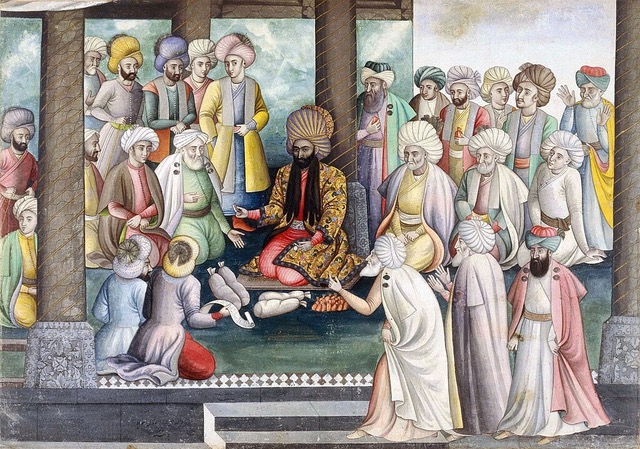
Distribution of Presents for the New Year by Shah Sultan Husayn painted by Muhammad Ali ibn Muhammad Zaman, Safavid, Isfahan, Iran, dated 1720-1721. British Museum, Public domain, via Wikimedia Commons
The Night Before the Big Cheleh
The ancient Persian’s concept of seasons included two periods – each known as a cheleh (چله) – that brought harsher weather: one in summer, and one in winter. As Kala Bi Kala explains, each cheleh was further divided into a “big” cheleh, comprising the first 40 days of a season, and a “small” cheleh, comprising the next 20 days. For winter, the big cheleh begins after Yalda, signifying that the cold weather will be intensifying.
The Birth of Mithra, the Sun God
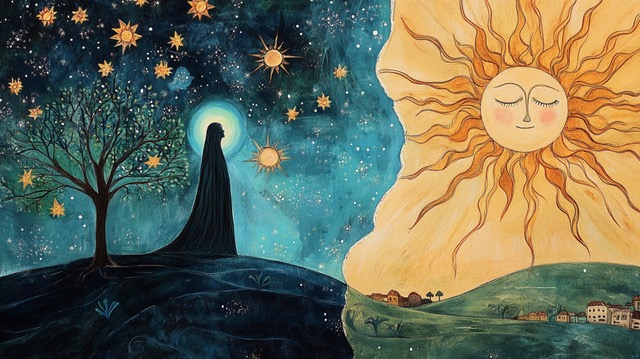
The word “yalda” is associated with birth and procreation from its roots in the ancient language Syriac, which was introduced to Persia (modern-day Iran) by Christian refugees from Rome. (The dialect Soryani is still spoken in parts of Syria and northern Iraq today.) In this context, the birth it’s referring to is that of the sun, personified by the god Mithra. Legend has it that on Yalda Night, the god Mehr appears in a hollow cave and brings the sun (i.e., Mithra). With Mithra’s return, he lengthens the hours of the day, reinstating the supremacy of the sun.
The Triumph of Good Over Evil
To a people whose lives were based on agriculture and animal husbandry, the sun’s light and warmth symbolized the goodness inherent in the Creator; by contrast, darkness and cold symbolized evil. As Digikala explains, ancient Persians came to believe that night and day, or darkness and light, were in a constant struggle. Longer days were a sign of the victory of light, and shorter days were a sign of the victory of darkness. Persians celebrated the longest night of the year because it meant that the days after it would gradually become longer, signaling that goodness would triumph.
Yalda Night: The Traditions
Celebrating Until the Sun Is Reborn
As stated before, Yalda celebrations have always lasted until dawn. Persians do this so that, as Namnak explains (as translated by Google), “the darkness, cold and sadness of the absence of the sun do not weaken their spirits, and they can go to bed with a clear sky and rest comfortably.”
The tradition for you: Plan an all-night celebration for the winter solstice.
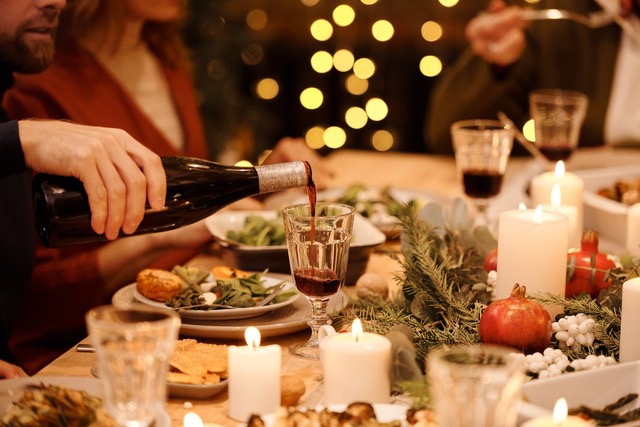
Photo by Nicole Michalou /pexels.com
Using Fruits and Nuts as Talismans
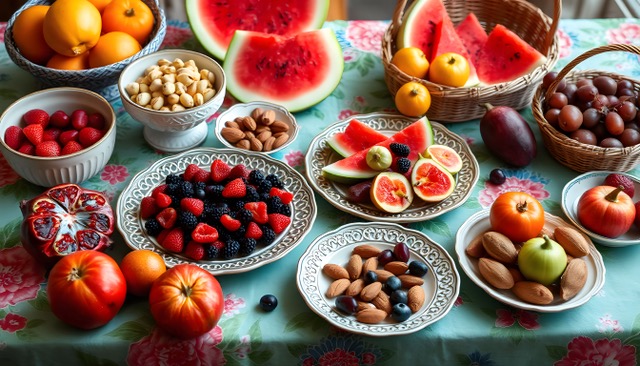
Yalda isn’t Yalda without the right fruits-and-nuts platter. These might seem like ordinary foods, devoid of any special meaning, but in the Persian tradition, they possess power.
Fruit with a lot of seeds contains the contagious magic of fertility. Red fruit in particular represents the mighty sun at night, offering protection from the harshest cold during the big cheleh. Oranges, apples, persimmons, pears, berries, figs and even pumpkins are part of any good Yalda spread, but the two rockstar Yalda fruits have always been watermelons and pomegranates. In addition to conferring fertility, watermelons symbolize life, health and vitality, and pomegranates symbolize happiness and the abundance of blessings and luck in life.
The nut selection typically includes pistachios, walnuts, almonds and hazelnuts mixed with chickpeas, raisins, seeds (hemp, pumpkin, watermelon, etc.) and wheat. In ancient times, these were mostly ingredients that were dried for long-term storage. Accordingly, they are archetypes of abundance, health and happiness.
The tradition for you: Make sure to have these fruits and nuts at your winter solstice party, and reflect on their significance as you enjoy them.
Reading Hafez’s Horoscope
For advice or answers to profound questions, Persians read from “The Divan of Hafez,” a book written by 14th century Iranian mystic/poet Hafez Shirazi. Here’s how it’s done, as told by Namnak (and translated by Google):
“If the intended audience wishes to read Hafez’s fortune, the grand master of the assembly who is about to read the fortune asks him to repeat this sentence to himself: ‘O, Hafez of Shirazi, you are the discoverer of every secret. I seek a fortune. Cast your gaze upon me.’ Then, they open the divan [Hafez’s book] and read the ghazal [poem] on the top right, because the answer is the divination.
“If they encounter the middle of the ghazal, the divination should be read from the beginning of the ghazal, that is, the back page. After the ghazal is read, they interpret it. If the divination comes out with a positive content, it means the divination is good, but if it is negative, it means it is bad. Of course, it should not go unnoticed that all of Hafez’s ghazals have an uplifting and romantic content.”
This is no parlor game or party trick though; it’s rooted in spiritual beliefs and prayer, sustaining a connection with the past and ancient knowledge. The answers and premonitions given are spiritual, and the poem read is considered to provide the answer to the querent’s question or advice for the querent.
The tradition for you: Address Hafez by name, and then ask him a question. Then, randomly select a page in “The Divan of Hafez” (free PDF here) and use whichever poem you find to interpret how it answers your question.
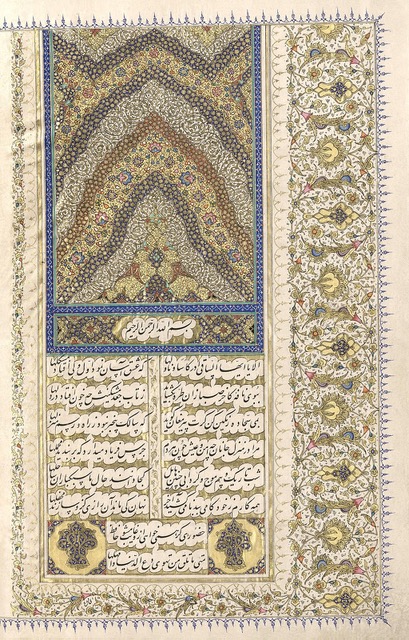
The Divan of Hafezمیرزا علینقی شیرازی, Public domain, via Wikimedia Commons
Learning Through Storytelling
The storytelling tradition pays extra respect to the elders in a family, for it is they who choose or create the stories to be told. Often, the stories are parables that revolve around Yalda symbols (light, darkness, etc.), shared as a means for the elders to educate the younger family members. According to Namnak, the stories tie in specific details about the storyteller’s life or city/province, and many use fairies, demons and animals as the protagonists and antagonists.
The tradition for you: Have someone at your winter solstice party – the elder, the better – share a parable or a life story that imparts a lesson.

Using Fire to Keep Evil Away
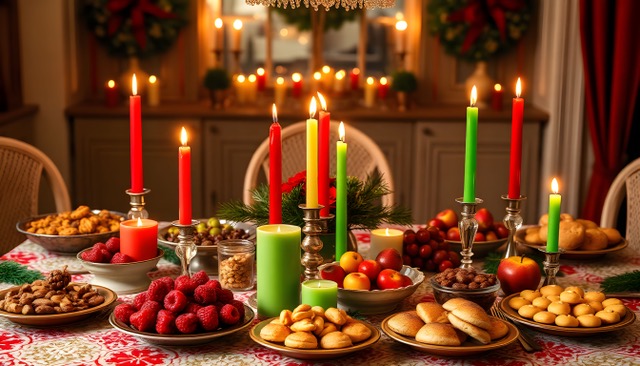
The ancient Persians believed that flames rescued and protected them from the evil forces around them at night, particularly the “eye of darkness,” which sought only harm. They would sit by a fire as a group, and their Yalda table would glow from candlelight. Candles were (and still are) typically red and green, as these colors are considered symbols of warmth, life, prosperity and happiness.
The tradition for you: Whether you’re sparking up incense (or a joint) for the party, lighting a candle on the table set for Yalda dinner or getting the fireplace roaring, set an intention when setting the fire. Focus on feeling and being protected by the same power that fuels the sun.
Making the Night Extra Special for Newlyweds
Yalda is one of the most special nights for Persian newlyweds, as it is customary to hold a special ceremony just for them. Basically, it’s a kind of post-wedding bridal shower, but for both the bride and the groom, and far more lavish and ritualistic. It’s focused on providing the couple with what they’ll need to kick off their new, cohabitating life together, and it’s an act of uniting the groom’s and bride’s families.
On Yalda, the groom’s family prepares beautiful gifts for the newlyweds, and the women in the groom’s family carry the gifts into the bride’s house on trays that they wear on their heads. (In modern times though, it’s more common to carry the gifts in elaborately decorated boxes, chests or wooden baskets.) At the bride’s house, an all-night party ensues with the two extended families.
Also, the mothers of the groom and the bride give a bundle of special Yalda foods to the couple, along with presents they’ve made themselves or commissioned to be handmade, such as dresses and jewelry for the bride. Namnak observes:
“As important as buying the gifts themselves is, the taste that is used in decorating these gifts is also very important and cannot be overlooked, because the more taste and flair that is used in arranging these gifts, the more it shows the love and affection between the two families. These decorations are made with colorful lace tools and special red ribbons, which are a symbol of Yalda. … Don’t doubt that the importance and value of a gift is not measured by its quantity, and its intention is more important. Therefore, prepare as many stylish gifts as you can for your bride and create an unforgettable Yalda night for yourself and your bride’s family.
The tradition for you: If someone you know has a wedding in early to mid-December this year, make this winter solstice an unforgettably beautiful experience for the couple.
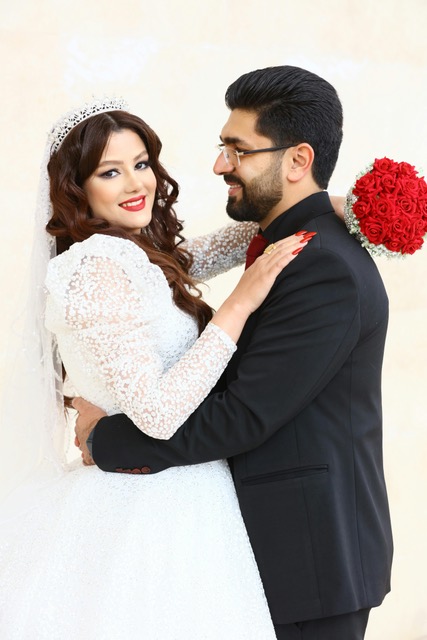
Photo by shakiba falahi/pexels.com
Stay up and have fun!
Whether you’re of Persian heritage or not, kick back on Yalda with some good friends, good snacks and good vibes for the start of winter. At its core, the holiday is about honoring the importance of human connections – something that can’t be understated in a digital era – and the persistence of light over darkness. So, keep the party going until the break of dawn.
Yalda mobarak (“happy Yalda”) from Head Magazine, everyone!
The information in this article and any included images are for educational purposes only. This information is neither a substitute for, nor does it replace, professional legal advice or medical advice, diagnosis or treatment. If you have any concerns or questions about laws, regulations or your health, you should always consult an attorney, physician or other licensed professional.
 Kathleen Hearons is a writer, editor, linguist and voice over actor from Los Angeles. She specializes in creative writing and research-intensive analysis and reporting.
Sources and Suggested Reading:
Bell, Gertrude Lowthian, trans. “Poems from the Divan of Hafiz.” London: William Heinemann. 1897. Accessed Dec. 14, 2025. https://traditionalhikma.com/wp-content/uploads/2015/03/The-Divan-of-Hafiz-English-Persian.pdf.
Dabiri, Ibrahim. “Philosophy, History and Customs of Yalda Night in Iran.” Digkala Mag. Dec. 18, 2021. Translated by Google. Accessed Dec. 13, 2025. https://www.digikala.com/mag/yalda-night/.
Eldridge, Alison. “7 Winter Solstice Celebrations from Around the World.” Britannica. Accessed Dec. 13, 2025. https://www.britannica.com/list/7-winter-solstice-celebrations-from-around-the-world.
“History of Shab Cheleh and Customs of Yalda Night.” Namnak. Translated by Google. Accessed Dec. 13, 2025. https://namnak.com/%D8%AA%D8%A7%D8%B1%DB%8C%D8%AE%DA%86%D9%87-%D8%A2%D8%AF%D8%A7%D8%A8-%D8%B1%D8%B3%D9%88%D9%85-%D8%B4%D8%A8-%DB%8C%D9%84%D8%AF%D8%A7.p179.
“List of Items for Yalda Night 1404.” Digikala Mag. Translated by Google. Accessed Dec. 14, 2025. https://www.digikala.com/mag/landing/yalda/.
“Mithra.” Britannica. Oct. 17, 2025. Accessed Dec. 14, 2025. https://www.britannica.com/topic/Mithra.
Nabavi, Faizeh. “Yalda Night 1404: History of Yalda Night and the Customs of Chele Night in Iran.” Kala Bi Kala. Dec. 11, 2024. Translated by Google. Accessed Dec. 13, 2025. https://kalabkala.com/blog/2129/%D8%AA%D8%A7%D8%B1%DB%8C%D8%AE%DA%86%D9%87-%D9%88-%D8%A2%D8%AF%D8%A7%D8%A8-%D9%88-%D8%B1%D8%B3%D9%88%D9%85-%D8%B4%D8%A8-%DB%8C%D9%84%D8%AF%D8%A7/.
Parsi, Touradj, and Shahin Sepanta. “The Iranian Festivity of birth or ‘Mehr’ (Mithra) During the Winter Solstice.” International Committee to Save the Archaeological Sites of Pasargad, Pasargad Heritage Foundation. Accessed Dec. 13, 2025. https://archive.savepasargad.com/December/The%20Iranian%20Festivity%20of%20birth%20of%20Mehr.htm.
Pirnia, Garin. “Reclaiming the Tastes of a Forgotten Persian Holiday at Christmas.” Thrillist. Dec. 20, 2019. Accessed Dec. 13, 2025. https://www.thrillist.com/eat/nation/iranian-christmas-holiday-celebration-persian-food-traditions.
Ra, Sean. “Yalda Night.” Ancient.com. Accessed Dec. 13, 2025. https://ancient.com/yalda-night/.
“What day is Yalda Night 1404?.” Tabdil. Translated by Google. Accessed Dec. 13, 2025. https://tabdil.app/time/yalda-night/.
“Yalda Night.” IranDestination. Accessed Dec. 13, 2025. https://irandestination.com/yalda-night/.
“Yalda Night Poems (A collection of pleasant and beautiful poems about the night of Chele and Yalda Night).” Roozaneh. Translated by Google. Accessed Dec. 13, 2025. https://roozaneh.net/fun/sms/%D8%A7%D8%B4%D8%B9%D8%A7%D8%B1-%D8%B4%D8%A8-%DB%8C%D9%84%D8%AF%D8%A7/.
“Yalda Night, the Longest Night Celebrated in Iran.” Rashin Travel. July 17, 2019. Accessed Dec. 23, 2025. https://rashintravel.com/yalda-night/.